Monday, August 4, 2008

Noriko's Dinner Table (Noriko no Shokutaku, 2005)


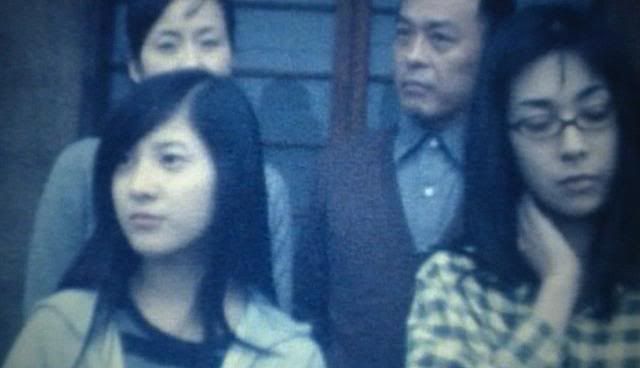
Sion Sono's 2½ hour tour-de-force follow-up to Suicide Circle (Club), Noriko's Dinner Table, might be a touch overwrought at times but I think every ounce is completely necessary for what Sono intends to accomplish. Both bracketing and running concurrent the events in Suicide Circle, Dinner Table (a story that nearly defies a written portrayal), is about 17 year–old Noriko Shimabara finding solice from her tired, small town home/existence in Haikyo.com's community forums as poster "Mitsuko", culminating in her running away from home in the midst of an electrical blackout; opportunity arrives in many forms. Noriko meets with forum mod Ueno54, a.k.a Kumiko, and without a place to go, is adopted into her family. As her storyline progresses, Sono then turns to Noriko's sister Yuka Shimabara's attempts to rationalize and discover the whys of Noriko's departure, which leads her to Tokyo as well. Maybe for the same reasons. Sono then turns to their father, then Kumiko for two more facets.

I've been vague not only because it would require spoilers (although I could argue there are no spoilers) but the film is told from different perspectives and gets a bit meta, lending to lengthy connections and reasons/motivations for everything that happens to the girls and their parents. Midnight Eye's review doesn't even attempt to parse the film; Mandiapple gives it a go. I'm doing this over lunch, at work, so time is an issue for me. In the end, I'm thoroughly satisfied with both it's originality and the connections with Suicide Circle. Yet, this is more a film among itself; think Miike's Black Society Trilogy.

I had reservations about the amount of Noriko's (sometimes third-person; unreliable?) voice-over narration, there's a lot, but those were allayed as Sono carried the essential narration into the other characters' contributions. Sono packs a hell of a lot into this film, including a few, not false mind you, semi-conclusions that honestly deepen his story with each progression. I dare say this could be Sono's masterpiece. We'll see.

Monday, July 21, 2008

You wanna know how I got these scars?

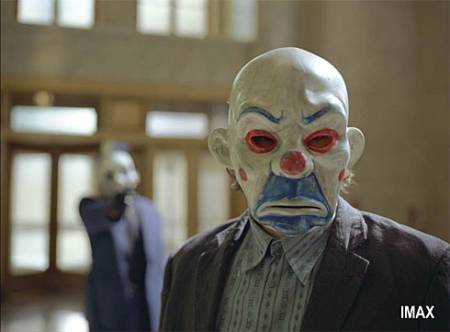
Not being a comic book fan has its advantages, but when it came to Christopher Nolan's The Dark Knight I've come to think it wouldn't have hurt to have been privy to some back-story. Then again the brilliance of Nolan's Kierkegaardian passage in the Batman Series is in its perceived contemporary tenets; rather, from what I'm told, the movie's deviation from source. I don't find fault here for obvious reasons. Dark Knight comes off a bit skittish, as if a dose of pedestrian might shatter the film's surface tension (it's no No Country), but once again it is comic book material. Where I soaked in every gallon of this movie can be found expressly in the wherewithal of Christian Bale, Heath Ledger (his first film called "Clowning Around"...you have to be kidding me), Aaron Eckhart, Gary Oldman, et al (peripheral characters included; with the possible exception of an ill-cast Maggie Gyllenhaal) insomuch as their respective gravities influence rather than dominate. Kudos to Nolan regular John Papsidera. A cast this good (and scrapped content?) might have warranted a run time closer to 3-hours. I'm thinking the next episode will be Joker-free... How could they...?

Other films have successfully posited the as bad as bad can get themes (J'ai pas sommeil/I Can't Sleep being the first that I thought of; and the aforementioned 'No Country') with a search for peace and/or escape, but none so mainstream, none so forceful (maybe a tad transparent), and none as controversial as The Dark Knight is turning out to be. For laypeople and aficionados alike. And this is where I saw it, btw.

Friday, July 11, 2008

A Streetcar Named Desire (1951)


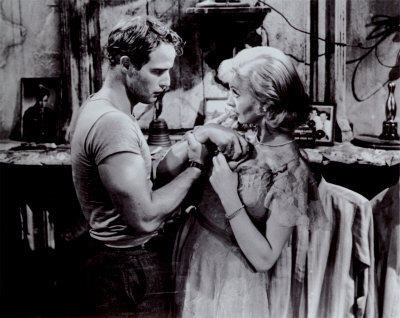
Without putting the adaptation into historical context, (because I haven't researched the movie's history or the play itself), I have to say A Streetcar Named Desire seems one of the most realistic and honest acted (by all involved) films around. Brando himself seems to disappear into the role of the down-to-earth Stanley. Stanley and Stella make the quintessential Orleanian couple, for their time, as they live foot-loose but deeply in love with each other, and they know each of the other is the only one for them. They quarrel now & again but the fights are usually either rooted in fun or serve as foreplay. Things change for them when Stella's hoity-toity sister Blanche shows herself and begins living with the couple.

Stanley clearly doesn't enjoy Blanche's elitist attitude and how it's beginning to rub off on Stella; or maybe more precisely awaken Stella as she may have been before her time with Stanely. It would be interesting to know the time when Stanley and Stella met. I can imagine Stella being just as aggravated if one of Stanley's relatives suddenly began staying in the apartment with no prospects and no plan to leave anytime soon, but in this case, Stanley is at his wits end when Blanche's story (of the past several years before showing up) doesn't check out and Stanley exposes Blanche's past. Let's just say it's a sorted past and whatever the road she traveled to get to the point where she hopped from hotel to motel, depending on the kindness of strangers , she's a bit used and a little lost in the mind to say the least.

We do know some of her story about Stella leaving Blanche in a troubled situation at home as kids for New Orleans, but it comes off as patronizing Stella and more than a little selfish...the very thing Blanche believes of Stella! As a matter of fact, I can identify with Stella somewhat in that respect. Blanche meets a would-be gentleman and the entire situation blows up in many areas; with Stella & Stanley, Stella & Blanche, Stanley & Mitch, Blanche & Mitch...it's a regular royal rumble of sorts. Throw in some card playing buddies and a close-knit, cheeky neighborhood and 'Streetcar' stands as maybe the best adaptation from a play out there (with Glengarry Glen Ross way up there also).

Monday, July 7, 2008

Wall-E & Hancock (2008)

Had the chance to see Wall·E (director Andrew Stanton) this weekend, and I acted. Wall·E is one of probably thousands of trash-compacting bots bent on rearranging a planet choked of post-consumer flotsam and jetsam for Man's eventual (or supposed) return from 700 years of planetary exile; so choked is the plant, that not a single organic remains on the surface. We've all seen the trailers, so I'll keep this brief. The storyline itself is fairly simple, honest, and loaded with that special type of Disney iconography and unobtrusive symbolism; i.e. when the first specimen of organic life is discovered by EVE (or ee-vuh, as Wall·E pronounces it), it's held inside EVE's stomach, then, a light is produced at the left-chest. Like I said, it's a straightforward movie. Never mind the comparisons to E.T., I guess. Mix in some Playskool environmentalism and a few gags on human detachment and rife obesity and there we have it. It's been said a thousand times that the animation is amazing, but especially incredible is the opening Earth scenes, about the first 20 minutes; the remainder wears more cartoonish. The only other thing, and it is a petty criticism, is the Dislovian dialogue (Disney + Pavlovian, if you'll indulge me) between the two bots which is nothing but repetitive waahl-ee's and ee-vuuh's sprinkled with emotion. I wouldn't say it irritating, but a hundred times later it approached my tolerance level. I genuinely expected the many children in the theater to begin parroting at any moment. To my surprise not a single one did.

Also saw Will Smith, Charlize Theron, Jason Bateman, et al in Peter Berg's Hancock but I have no real thoughts on this one, probably because it's terrible. I'll simply paraphrase a chunk of my Paradise Villa (Park Jong Won, '02) review from nearly 3 years ago to the day:

The main problem is that it's just there. It takes itself too seriously to be considered a comedy; too dry to be camp (where it might have had a fighting chance); too base to be considered drama. It just doesn't have a home, so I was left detached and unconvinced in any case.

Had a great 4th of July extended weekend. Lots of fireworks, a few adult beverages, a bit of grilling, perfect weather; couldn't ask for more. Hope everyone did the same

Friday, June 20, 2008

301, 302 (aka 301/302, 1995)


301, 302 begins as a Columbo-esque detective knocks on a lovely woman's door. Why is he there? Because the woman in Apartment 301 was, presumably, the last person to see her neighbor alive. He asks several questions about who her neighbor, in Apartment 302, is and how she, "301", came to know "302". Naturally, as a new resident of the building, she doesn't really know anyone in the building at all. Naturally.

The woman in Apartment 302 is sort of a recluse, in a sense. She goes about her business, but seems, for all intensive purposes, to prefer the confines of her home. "302" is a lithe, almost gaunt, creature in her mid-30's who writes for a living. "301" (Eun-jin Bang) has only just moved into the space across the hall from "302" and immediately began renovating the smallish apartment to suit her immense love of cooking. Much to the chagrin of "302", who get to put up with the noise of reconstruction. Soon after, "301" invites herself into her new neighbor's apartment to become friend's and to share with her some fine cooking. "301" becomes tremendously adventurous with her cooking when she realizes that "302" (Sin-Hye Hwang) refuses even the simplest of dishes, and flat out refuses to eat dishes containing meat. "301" figures she can help her neighbor out with that. She disguises meals in order to trick "302" into eating some pretty exotic stuff, but only after some brief unpleasantness. Both woman soon become friendly with one another and quickly feel compelled to share stories of brutal childhoods and passionless marriages.

"301" also speculates (while talking with the detective as they both browse around "302"'s apartment) that "302" is sexually repressed because she won't enjoy the great food she cooks and brings her. This is mainly because "301" admittedly places her passion for the culinary arts and her carnal passions in the same category; which she does consciously and is partly the reason she is where she is. "302" dismisses that, but goes on to tell her story of a traumatic childhood that may shed light on the problem "301" desperately wants to remedy using food.

301/302 isn't exactly a thriller, as billed. Made in 1994 or '95 or'96 (depending on where you look), it probably shocked it's share of viewers. There are a few pretty graphic sex scenes (some tasteful; some not) and some brilliantly shot cooking scenes. The camera gets right in the pots and pans, blenders and colanders. It also gets mighty close to the people's mouths, at a few points, to graphically illustrate "301"'s succulent eats being enjoyed. A major theme I came away with was that a woman (like "301", for instance) shouldn't be taken for granted. Part of "301"'s story, as told to "302" through several well done flashback sequences, is how the life and passions of her marriage were wasted on an ungrateful, selfish husband. But that's not all of her story. The middle third is. almost exclusively. a brilliant and moving account of "301"'s trials and tribulations that surround her cooking; along how it mirrors and, at times, commands her life.

Along with all of this, there's humor (albeit black) sprinkled in to set up the movie's touted ending; which some may see coming fairly early. That shouldn't take away from a well written film. I suspect 301, 302 is a hidden gem that many have either overlooked or have never came across. I highly recommend it, in any case.

Sunday, June 15, 2008

Drag Me to Hell (2009)

A cash out refi would have solved a lot of problems here.


The first impression Drag Me to Hell made on me was that this could be the the most creative horror film in quite some time, let alone stateside horror — the second was that there is some sinister groundwork behind the Raimi Bros' (Sam Raimi and Ivan Raimi) screenplay. I'm not talking about the demonic character called Lamia, or the crazy seance, or even the curse itself, I'm talking about the Christine character and her specific personal tribulations. Sure, in all likelihood the story is just a wild throwback to late 70s/early 80s cult horror like Phantasm, Psychomania, and House — or even earlier thrillers such as The Horror of Party Beach; but strip away the sizzling effects and colorful dialogue, and buried somewhere inside is some ominous kernel that set this script in motion.

The basis of Drag Me to Hell is as confounding as any that have ever propelled a film; a public shaming. To wit: an Eastern European gypsy (is there any other) is reduced to begging upstart mortgage officer Christine Brown (Alison Lohman) for a third, or was it a fourth, extension on her home loan — but with the pressures of the market and Christine currently angling for the newly vacant managerial desk, she regrettably denies the extension. Now enraged from having to humiliate herself, Sylvia The Georgian Gypsy Ganush becomes unhinged, launching into not so veiled threats which lead to Ganush ambushing Christine in the bank's parking garage — culminate in Grandmother Ganush placing a curse on Christine.

The mortgage device is as ham-handed as it is relevant, but more importantly it is just innocuous and pervasive enough to pass as passing motivation without a second thought. The remainder touches on every canon in B-horror film-dom, giving us everything from possessed handkerchief and a possessed dessert to foul-mouthed goat and the very act of being physically pulled directly into hell somehow all comes off as worthy.

As for the underlying nature of Drag Me, I' m sure that the Christine Brown arc is rooted in reality's soils — if only so much as to be based on the generic small town girl in the big city character, with a less-than desirable experiences abound. But all human tragedy and supposition aside, Raimi's film is most definitely a breath of fresh air for American comedy-horror, and for any fan who craves an accessible and excitable theater experience.

Sunday, May 18, 2008

Kadokawa Mystery & Horror Tales Volume 2 (2005)


Kadokawa Mystery & Horror Tales Volume 2 (2003) features three more short films from Global Fright Cinema and Kadokawa Pictures.

I have to admit, this installment in the Kadokawa series is somewhat better, and dare I say more intriguing than the previous volume. Could it be due to a larger budget? Or a superior effort in the writing department? I'd say the latter, for the most part. Stronger premises, unique twists, along with tried and true elements that are used to bring the stories as a whole together. Director Sato Takayuki makes his debut in the series (Last Day as a Teenager & Regeneration). Kenji Nakanishi makes a valiant return form Volume 1 (Desire To Kill) to direct Wooden Clogs With The Red Straps, which is my favorite of these three. The look remains low-budget indeed, but the substance takes a step up. A tad more star-power and tighter camerawork make the films more approachable also. This is truly a case of "it won't blow you away, but it's worth a look". If not for a pleasant surprise in the storytelling department, then give it a shot to see what some up-and-coming directors have to offer.

The Wooden Clogs With The Red Straps / d. Kenji Nakanishi / 37 min

This short film, simply called Wooden Clogs on the DVD, features Chiaki Kuriyama (Kill Bill's Gogo Yubari, as if I had to clarify) as Yoshie, a young, beautiful, yet reclusive daughter of a rural family that's visited by a research graduate from Tokyo (played by Naoto Ogata). While he's only there for post-graduate studies, he stumbles quite accidentally into Yoshie and forms a bond of sorts. It takes some time for the two to start a dialogue and for Yoshie to feel comfortable around the "big city house guest", as her drunken, boorish father calls him. Her physical infliction plays a large role in her self-confidence also. When the family notices that their guest has observed Yoshie stealing away to a grand Shinto temple on the property, they advise, and ultimately warn him that he is not to follow her into the temple. But one night, he can't shake his curiosity and does follow her down the wide dirt path, through a grand, wooden torii gate and ultimately up the stairs, past the geta sandals with the the red cloth straps into the dark hall of the temple where he learns a deeper, sadder family secret.

Regeneration / d. Sato Takayuki / 36 min

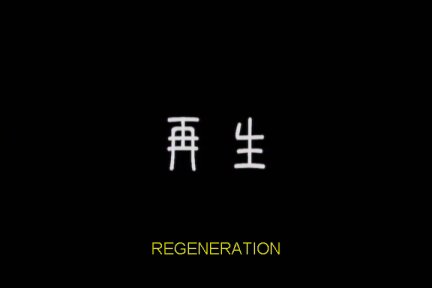
Regeneration is a story about a college student named Yui (played by Tsugumi; Long Dream) who introduces herself to a former college professor (Tohru Kazama) she sees sitting with head in hands in a hospital waiting area. The reason he's there, he explains, is to get help for his alcoholism and mental depression. They begin to see each other regularly and she soon moves into his apartment. The irony for him is that he realizes rather quickly that she's not the fun, easy-going woman she appeared to be, she turns out to be a self-abusing alcoholic and admitted sexual veteran; for which he's alternately repulsed and tantalized. They seem to be made for each other until "professor" and Yui (as she insists on calling him, much to his chagrin) begin to talk marriage. Yui admittedly feels the same, but she awkwardly delays because of an unbelievable series of tales she knows she has to tell him. The film opens with the professor lying on a sofa, clutching a bottle of whisky in a drunken stupor. As the scene widens, Yui sits quietly in a chair opposite him...with no head! Regeneration brings the story back to the beginning to show how they got there, and then progresses past that room for a shocking conclusion.

Last Day as a Teenager / d. Sato Takayuki / 28 min

The final "episode" is called Last Day as a Teenager. And quite literally, it tells a tale of a college student named Tomoya, who is trying to escape a curse put on him by a pint-sized Angel of Death; three years prior, that will culminate the day he turns 20 years old. He's in such a position due to making a deal with the child-wraith to save the life of his childhood friend, now quasi-girlfriend, Koko (Aki Maeda; Battle Royale 1 & Battle Royale 2) who was pulled from the water by Tomoya to save her from drowning. As he performs CPR, he begs into the air for some sort of divine help. Koko begins to breathe again when Tomoya cuts a deal with the Angel of Death where he will give his life to the wraith in exchange for saving Koko. But as you might expect, he shouldn't trust the wraith to be honest about the deal.
Monday, May 12, 2008

Kadokawa: Mystery & Horror Tales: Volume 1 (2005)

A collection of 3 short Japanese Horror films. Volume 1 DVD of a Region 1, 3-part series from Global Fright Cinema and Kadokawa Pictures.

Meinichi / d. Tomoyuki Akashi / 40 min.

A good-looking family of four approaches their new house and is met by a family friend (or maybe the real estate agent?). Everyone seems happy to be moving into the new house, which will be a welcome breathe of fresh air from the hectic Tokyo home they left. But the main reason seems to be for the benefit of one of the family's two daughter health. That daughter, Minako, had a complete breakdown after her boyfriend is killed, and seems to wonder through life in some sort of comatose, hazy daze. With a twisted grin. Her sister, Yukio (Asami Mizukawa; Dark Water, Shibuya Kaidan), begs her sister to go on with her life but the morose Minako is visited by the ghost of a young girl who used to live in that house. What stands out immediately, from the first images that appear, is the camerawork. Most of the shots are in frame, but the ones that aren't are badly out. The action and the actors are shot far too close also. That's not saying the video is poor, on the contrary, the definition is crystal clear; so much so that I felt as if I could reach right into the movie to grab a banister or push a door open. Those positive attributes aren't nearly enough to save this amateur escapade. I'll try not to mention that almost nothing is explained in this "episode" and only the most superficial motives are apparent. Combine that with lack-luster, cheesy special effects, and you have an almost entirely forgettable experience.

Cruel Kidnapping / d. Tomoyuki Akashi / 32 min.

Laughably bad in every way. A dim-witted, bumbling, former big-shot money-man gets himself embroiled in a kidnapping plot that involves not only his own child, but the child of a well-to-do acquaintance. In order to get his baby back safely, he must come up with 30 million Yen (just over $250,000 USD & $300,000 Canadian -- [edit] at the time I wrote this, that is). But his "brilliant", spur-of-the-moment strategy to find the funds puts him into a very bad position. The story is easy enough to follow, although it's barely worth doing so. A few comical scenes and takes from the Toshio character.

Desire to Kill / d. Kenji Nakanishi / 33 min

The best of the three in this volume. It follows a middle-aged woman, Rei, who lives in a cramped apartment building. Her immediate next-door neighbor is constantly lording over the other tenants and poking her nose into their lives; seemingly waiting for the other tenants to do something "wrong" or hounding them inexplicably. One day, Rei refuses to throw out a bag of trash because her old, bitter neighbor is seen rifling through people trash. She wants to time the service pick-up just right so she can avoid the old lady's interest. Alone at home, (her husband is out of town on business), she grabs an umbrella and rushes into the stormy night to pitch her garbage and gets pushed back into the apartment by a dark stranger, no sooner had she opened the door. With just her sleeping son with her, she has to make it through a tense night with a young man who has killed once already that night. A fairly good "episode", all told, but suffers from the same level of tedium as the previous two "episodes". It's only redeeming element is the hint of a genuine story and a mild Twilight Zone-ish ending.